Author: admin

  • The Real Cost of Cheap Clothing

    The Real Cost of Cheap Clothing

    Thanks to shows like Extreme Couponing, Americans are always looking for bargains. One industry where that obsession with the cheapest price is most obvious is in clothing… and women’s fashion. Not that long ago, a television news photographer photographed First Lady Michelle Obama as she shopped for clothing at a Washington D.C. Target store.

    H&M Store OpeningThe popularity of outlet stores, discount stores and value retailers are proof of this wish to buy things for the cheapest price. Wal-Mart, Target, Old Navy, H&M, Forever 21, TJ Max, DSW, are just a few examples of retailers catering to our un-satiated appetite for low priced fashion. Even luxury retailers like Saks Fifth Avenue have joined the outlet craze with their Saks OFF Fifth stores. Putting aside the question of quality, modern shoppers, not only Americans, but in most developing countries, simply cannot resist the urge to consume clothing and accessories at alarming quantities.

    Is It Really a Bargain?

    Women always feel pressure to look good, to wear clothing that’s in style, and to be the first among their friends to fill their closet with the most popular and cheapest fashion. Women are in competition with each other to see who can get the most clothes, fill their closet faster, and pay less for their haul. Cheap clothing is encouraging an obsessive behavior, especially with women, many of whom self describe as shopaholics.
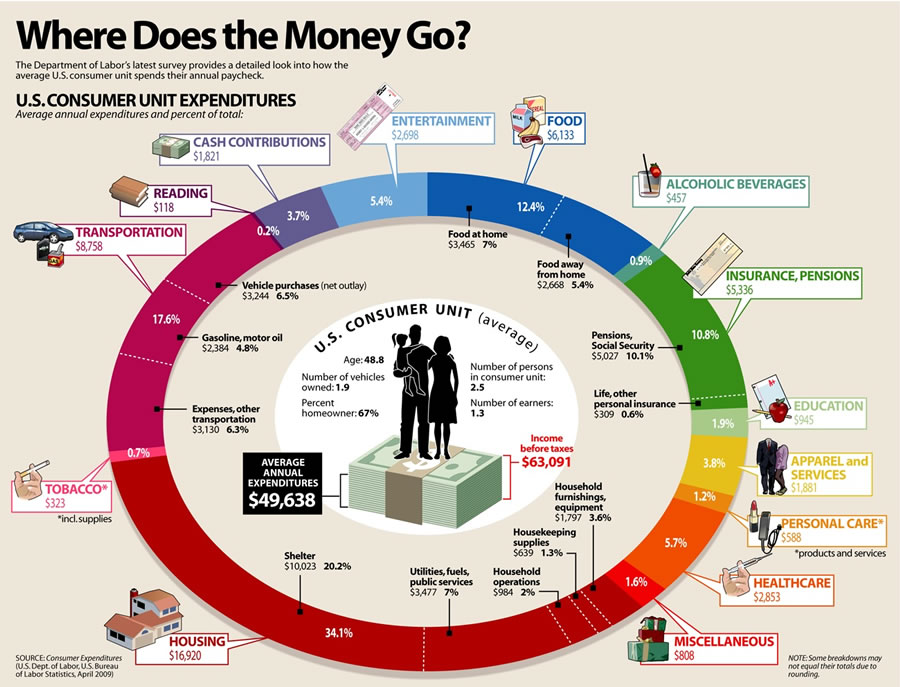
    Consumer Spending by CategoryThe numbers very much support the obsession. According to the latest Department of Labor Survey, the average Consumer Unit (that’s 2.5 people) spend almost 4% of their $49.5K annual expenditure on Apparel and Services, that’s almost  $1700 and double the amount  we spent  on clothing 20 years ago. Considering our obsession and the fact that much of this money is spent impulsively on items no one really needs, it makes you wonder about the real price of cheap fashion.

    What about the Social Price?

    Most of the cheap clothing Americans are buying wasn’t made in the United States. China and Bangladesh are two of the main sources of import, roughly 40,000 factories in China, and 5,000 factories in Bangladesh, employing about 4 million workers. Bangladesh, where the poverty rate is among the highest in the world, pays the the average garment industry worker about $37 per month. Chinese workers make about $200 per month. The $20 billion a year industry is no doubt a major economic force in Bangladesh, but as important it is, it is far from being rewarding for its workers.

    In April of 2013, a tragic building collapse on the outskirts of Dhaka in Bangladesh killed no less than 1100 people, almost all of whom were garment workers. Recovery workers pulled another 2400+ people who survived the nine-story building collapse, from rubble. There were also reports that only 18 building inspectors were responsible for overseeing the safety of 100,000 garment factories. Disregard to basic safety standards, extremely low minimum wage standard, finally brought about change when workers took to the streets demanding the closure of 400 factories. The result, a 77% increase in minimum wage to $68 per month. Think how bad it was it for Bangladeshi that such a “steep” increase was so quickly adopted.

    Will this affect the price we pay for our obsession? It’s too early to assess… Was it only the price global retailer and brands paid for the garments manufactured in these factories? Or was it the greed of factory owners? Only time will tell us how this impact what we pay at the register. But the more important question we should ask is, why is this industry exempt from the critical review of its supply chain? Why do we like to scrutinize Apple’s oversight of its manufacturing operations in China, but criticize H&M only after the catastrophe that cost 1100 people their lives?

    No one can help the Bangladeshi workers better than the Bangladeshi worker. Taking to the streets, demanding better pay, and safer healthier work environment is much more effective than the faint outcry sounded by the west following the Dhaka disaster. But surly we can sleep better in our $9.99 Target’s pajamas and walk prouder in our $19 Old Navy cropped pants if we did our part and demanded that Corporate’s Global Responsibility activism did not come after the fact.
  • Airlines Price Scheme Revealed

    Many things changed with the airline industry since 2011. To avoid oblivion, airline executives had to become creative, sometimes criminally creative, to stay in the game. Finding ways to generate more revenues is responsible for some of the most bizarre pricing scheme ever for consumer consumer facing products. Have you seen the airline ticket where 70% of the total cost is taxes and surcharges?


    Here are some fees charged to a typical airline tickets


  • The One Trillion Dollar Question

    The One Trillion Dollar Question

    It doesn’t take a college degree to appreciate the looming student debt crisis. Student loans are now the second largest source of individual indebtedness in the US, between mortgage and credit card debt.

    The table below demonstrates the current state of individual debt in the US as of early 2014. The amounts, taken from multiple sources, rely on data published by the Board of Governors of the Federal Reserve. (http://www.federalreserve.gov/). Not all the numbers are available on the Federal Reserve reports and some extrapolations using data series from sources, like credit card, student or housing organizations, were needed to complete this overview. Nonetheless, this information provides a good overall idea of how big the debt burden is and how many individuals are affected. Hopefully this will help us better understand the true impact each type of debt has on the indebted individual potential for economic success.

    Debt   Type Total   Amount owed Affected   Population Avg   amount owed
    Mortgage $9.37  trillion 61 million $152,000
    Student Loans $1.08  trillion 37 million $29,400
    Credit Card $856   billion 69 million $15,200

    Housing and mortgage debt
    We don’t have much to add to the torrent of articles written about the housing market in the wake of the financial crisis and the large scale mortgage defaults. We are only interested in the data because it gives as an opportunity to examine the affordability of this debt burden. Naturally when examining averages there is much that is lost at the extremes, individual stories of defaults and unaffordable mortgages. But averages can tell a story and the $152,000 avg. mortgage at an avg. 4.75% interest rate over 30 years translates to payment of $792 per month.

    With median household income of $52K (avg is much higher standing at approximately $69K), mortgage debt accounts for about 18% of household income and ON AVERAGE is an affordable burden.

    Student loans
    The first thing to point out about student loans debt is the 37 million ex-students with the avg burden of $29,400 refer to individuals than households. This is an important observation considering the basic sociological postulate of marrying within your social group. People with a college degree are likely to marry people with a similar level of education which is likely to increase the household burden to $58,800 or more.

    About 20 million Americans attend college every year, and 60% of them borrow to cover cost of college. Of the 37 million indebted students 23 million are over the age of 30, many well into their 50’s and 60’s and still paying out their student loans. (for a full breakdown of who borrows and other interesting stats: http://www.asa.org/policy/resources/stats/)

    According to CNN money the class of 2013 owes an average of $35,200. And with tuition and fees rising at rate of 5% per year this number will only go up.

  • Atlanta Housing Market

    Atlanta Housing Market

    One of the hardest hit housing markets in the 2008 financial crisis
    quick stats according to Zillow (03/2014)

    The median home value in Atlanta is $145,300. Atlanta home values have gone up 15.7% over the past year and Zillow predicts they will rise 4.8% within the next year. The median list price per square foot in Atlanta is $153, which is higher than the Atlanta Metro average of $90. The median price of homes currently listed in Atlanta is $189,900 while the median price of homes that sold is $231,465. The median rent price in Atlanta is $1,100, which is higher than the Atlanta Metro median of $1,050.
    Market temperature is cold, which is good news for home buyers.

  • The Real Cost of College Education

    The Real Cost of College Education

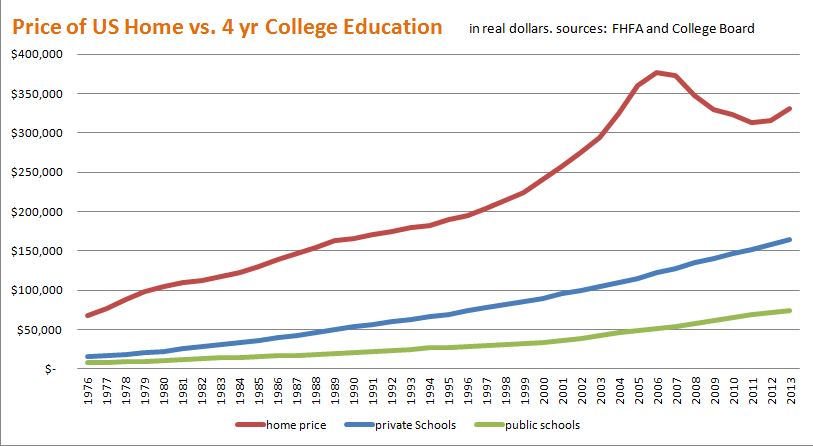
    Let’s examine two sets of numbers if for nothing else, for being probably the largest and most important and the largest single investment in our life. With an eye to college education expenditure, over a period of 4 years how does it fare against what we perceive as the most important single investment   our home.

    In the past 40 years, the average cost for a four-year college education (tuition, room and board) in the U.S. has gone from about $2,400 to nearly $30,000 per year today. Adjusted for inflation the price went up from $12,700 to $30,000. When compared to housing, the average home price 40 years ago was about $35,000 and today $331,000. Adjusted for inflation home pricing went up from $172,000 40 years ago to $331,000.

    HomeAndCollegePriceCharts

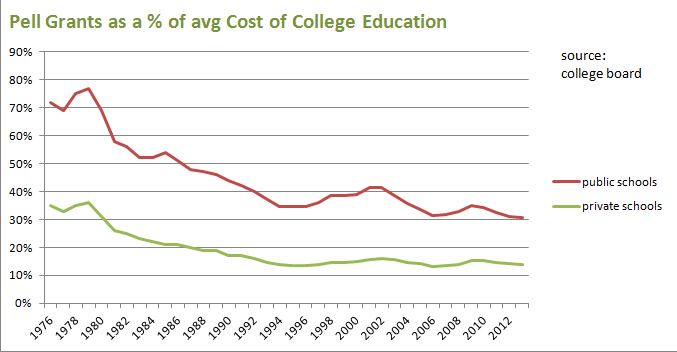
    The percentage of students carrying debt has shot up from less than half to nearly 70 percent. The avg. price tag of private colleges with room and board is $40,130, up 60% in the past ten years from $25,060. The ratio of Pell Grant to the cost of college education did not change much in the past 10 years and it stands on 14% in private schools and 31% of the cost of public schools.

    Pell Grants Chart

  • Wireless Price War

    Wireless Price War

    [rev_slider wireless_providers]

    Recent data on wireless price suggests an average monthly bill of $61.15 up from $55.80 in the first quarter of 2010. Does this indicate a price war between cellular service providers? This would hardly be the case. But why do consumers think that a price war is underway?

    Lets examine the options:

    Sprint’s “Framily” plans, a group of at least seven people will get unlimited talk, text and 1 GB of data for $25 per month per line. Family members can each pay $20 per month per line to buy unlimited data and new phone every year. To get this seemingly attractive price, seven or more people have to join the group. For individual account, the cost could be as high as $75 per month and as low as $55 per month per line for unlimited talk, text and 1 GB of data.