Search results for: “”

  • Privacy Policy

    Who we are

    Our website address is: https://www.pricewize.com.

    Comments

    When visitors leave comments on the site we collect the data shown in the comments form, and also the visitor’s IP address and browser user agent string to help spam detection.

    An anonymized string created from your email address (also called a hash) may be provided to the Gravatar service to see if you are using it. The Gravatar service privacy policy is available here: https://automattic.com/privacy/. After approval of your comment, your profile picture is visible to the public in the context of your comment.

    Media

    If you upload images to the website, you should avoid uploading images with embedded location data (EXIF GPS) included. Visitors to the website can download and extract any location data from images on the website.

    Cookies

    If you leave a comment on our site you may opt-in to saving your name, email address and website in cookies. These are for your convenience so that you do not have to fill in your details again when you leave another comment. These cookies will last for one year.

    If you visit our login page, we will set a temporary cookie to determine if your browser accepts cookies. This cookie contains no personal data and is discarded when you close your browser.

    When you log in, we will also set up several cookies to save your login information and your screen display choices. Login cookies last for two days, and screen options cookies last for a year. If you select “Remember Me”, your login will persist for two weeks. If you log out of your account, the login cookies will be removed.

    If you edit or publish an article, an additional cookie will be saved in your browser. This cookie includes no personal data and simply indicates the post ID of the article you just edited. It expires after 1 day.

    Embedded content from other websites

    Articles on this site may include embedded content (e.g. videos, images, articles, etc.). Embedded content from other websites behaves in the exact same way as if the visitor has visited the other website.

    These websites may collect data about you, use cookies, embed additional third-party tracking, and monitor your interaction with that embedded content, including tracking your interaction with the embedded content if you have an account and are logged in to that website.

    Who we share your data with

    If you request a password reset, your IP address will be included in the reset email.

    How long we retain your data

    If you leave a comment, the comment and its metadata are retained indefinitely. This is so we can recognize and approve any follow-up comments automatically instead of holding them in a moderation queue.

    For users that register on our website (if any), we also store the personal information they provide in their user profile. All users can see, edit, or delete their personal information at any time (except they cannot change their username). Website administrators can also see and edit that information.

    What rights you have over your data

    If you have an account on this site, or have left comments, you can request to receive an exported file of the personal data we hold about you, including any data you have provided to us. You can also request that we erase any personal data we hold about you. This does not include any data we are obliged to keep for administrative, legal, or security purposes.

    Where your data is sent

    Visitor comments may be checked through an automated spam detection service.

  • The $1000 a year Smartphone Addiction

    The $1000 a year Smartphone Addiction

    SmartPhone Addiction

    Just a few years ago, the word “smartphone” did not mean much to anyone, but since then it has made its way into the lives and pockets of millions of people worldwide. Aside from carrying out the basic functions that cellphones were first designed to perform, smartphones offer a seemingly all-encompassing and ever-expanding range of capabilities. Many of us have happily discovered that our common, everyday issues can now be cured with the press of a touch-screen button and the utterance of the glorious phrase, “There’s an app for that.”

    But all of these benefits certainly come at a cost, and a high one at that.

    It is no secret that the cost of smartphone production is miniscule in comparison to the retail prices they sell for, but consumers still continue to get in line every time a new Samsung Galaxy or iPhone is released on the market. In a comprehensive smartphone price survey, Forbes contributor Tristan Louis finds that a smartphone like one of the Apple iPhone or Samsung Galaxy models can cost up to $650 when purchased upfront in cash, and that price does not even reflect the additional costs of a carrier contract plan, monthly phone bill, and phone accessories. Assistant Editor of technology review website TechHive.com, Leah Yamshon, points out that when you total it all up, American smartphone users spend an average of over $1000 dollars a year on a device the size of their hand.

    So you may now be looking down at your own iPhone 5 and asking it, “Why have you done this to me?” But there is more to the love story of the unreasonably priced smartphone and the infatuated consumer; aside from the obvious technological services these cellphones offer, they have become a major part of our social interactions. Internet Retailer contributor Bill Siwicki notes that A Pew Research study conducted in 2013 revealed that 64% of mobile phone users in the United States opted for smartphones in their most recent phone purchases, showing the wide span of the smartphone user network. With this many people using them daily, smartphones have become one of the most popular tools of connection and communication through the many different social media outlets that can be accessed with ease on mobile devices.

    In addition to making the user more socially available, the smartphone offers the promise of a secure social status. The higher the price of the smartphone the more capabilities it often possesses, but price also factors into the social cellphone hierarchy. A cellphone is one of the first things many people look to in order to make quick assessments of each other’s personalities and social standing. In this way, the overly expensive smartphone has become a marker of financial stability, social awareness, and the ability to fit in with the rest of society. Though we may be false in making these assumptions about others, cellphones and their relative prices are often one of the first tools we use to get a feel for strangers.

    You may call these smartphone users naïve, you may call them obsessed, you may be one of them yourself—either way, the pricing, or overpricing, of smartphones is changing (social) life as we know it.

  • Painful Choices

    Painful Choices

    I’ll share an experience involving a beautiful and statuesque model named *Angelica. Angelica’s big brown eyes and thick brown hair are captivating.

    Angelica could wear anything from string bikinis to sophisticated designer gowns. I constantly booked her.

    She started having ongoing and painful problems with her feet. Of course, the trendy four inch high heels didn’t help. I finally suggested that she might want to consider going to a foot doctor, but she said she just didn’t have the money.

    Things got worse, and I suggested that she soak her feet in warm water every night followed by a cooling rinse. I started paying for a cab to send her home. This helped a little.

    High Heels

    The Plaza Hotel…a Testament to Timeless Elegance

    In the middle of an intense 5 day show at The Plaza Hotel in New York City, I started hearing bits and pieces in the model’s room about fashion. A day later, Angelica was so excited about a pair of Frye knee high Lucinda Slouch black leather boots. This was nothing unusual because the girls loved fashion.

    The very next day, Angelica came prancing into the model’s room with a totally Fab pair of $500.00 Frye Lucinda Slouch black leather boots. No question that her eyes were gleaming.

    It was obvious that the boots spoke to her heart. Angelica was so besotted with them, she paid retail using a credit card with double digit interest. She became an instant fashion princess with all the other models who were making a fuss over her and the boots. Lots of high-pitched estrogen in the room.

    When things finally calmed down to some extent, I gently pulled her aside to ask her about her feet and whether she’d made plans to see a foot doctor. She told me I was right, and that she’s putting money aside. Then, Angelicas started crying, hugged me and said she had to leave.

    She probably had mixed feelings about her choice of giving higher importance to the boots over the much needed visit to the doctor. Many people frown upon women’s poor judgment when it comes to fashion, pointing out that for some, buying fashion forward clothing, jewelry, etc., is more important than paying for healthcare or education.

    I don’t judge Angelica in this manner, after all this is her occupation and the boots could be a legitimate professional expense depending on the circumstances. No one would look down at a graphic designer choosing to delay dental work expenses in favor of the latest model of MacBook Pro. You might ask why anyone should have an issue with a model investing in what she perceives to be boots that might help promote her career?

    My only advise for Angelica is to be smart … unlike many other businesses, fabulous fashion products are available at deeply discounted prices. Models also have access to private discounted sample sales that are not open to the public. Additionally, she can do much better marching to her own fashion drummer by creating or designing things of personal value…

    And my last piece of advice is that if she gets to the point where she can’t walk, what’s the point of those beautiful and expensive boots?

    *The models name has been changed to protect her privacy.

  • The Real Cost of Cheap Clothing

    The Real Cost of Cheap Clothing

    Thanks to shows like Extreme Couponing, Americans are always looking for bargains. One industry where that obsession with the cheapest price is most obvious is in clothing… and women’s fashion. Not that long ago, a television news photographer photographed First Lady Michelle Obama as she shopped for clothing at a Washington D.C. Target store.

    H&M Store OpeningThe popularity of outlet stores, discount stores and value retailers are proof of this wish to buy things for the cheapest price. Wal-Mart, Target, Old Navy, H&M, Forever 21, TJ Max, DSW, are just a few examples of retailers catering to our un-satiated appetite for low priced fashion. Even luxury retailers like Saks Fifth Avenue have joined the outlet craze with their Saks OFF Fifth stores. Putting aside the question of quality, modern shoppers, not only Americans, but in most developing countries, simply cannot resist the urge to consume clothing and accessories at alarming quantities.

    Is It Really a Bargain?

    Women always feel pressure to look good, to wear clothing that’s in style, and to be the first among their friends to fill their closet with the most popular and cheapest fashion. Women are in competition with each other to see who can get the most clothes, fill their closet faster, and pay less for their haul. Cheap clothing is encouraging an obsessive behavior, especially with women, many of whom self describe as shopaholics.

    Consumer Spending by CategoryThe numbers very much support the obsession. According to the latest Department of Labor Survey, the average Consumer Unit (that’s 2.5 people) spend almost 4% of their $49.5K annual expenditure on Apparel and Services, that’s almost  $1700 and double the amount  we spent  on clothing 20 years ago. Considering our obsession and the fact that much of this money is spent impulsively on items no one really needs, it makes you wonder about the real price of cheap fashion.

    What about the Social Price?

    Most of the cheap clothing Americans are buying wasn’t made in the United States. China and Bangladesh are two of the main sources of import, roughly 40,000 factories in China, and 5,000 factories in Bangladesh, employing about 4 million workers. Bangladesh, where the poverty rate is among the highest in the world, pays the the average garment industry worker about $37 per month. Chinese workers make about $200 per month. The $20 billion a year industry is no doubt a major economic force in Bangladesh, but as important it is, it is far from being rewarding for its workers.

    In April of 2013, a tragic building collapse on the outskirts of Dhaka in Bangladesh killed no less than 1100 people, almost all of whom were garment workers. Recovery workers pulled another 2400+ people who survived the nine-story building collapse, from rubble. There were also reports that only 18 building inspectors were responsible for overseeing the safety of 100,000 garment factories. Disregard to basic safety standards, extremely low minimum wage standard, finally brought about change when workers took to the streets demanding the closure of 400 factories. The result, a 77% increase in minimum wage to $68 per month. Think how bad it was it for Bangladeshi that such a “steep” increase was so quickly adopted.

    Will this affect the price we pay for our obsession? It’s too early to assess… Was it only the price global retailer and brands paid for the garments manufactured in these factories? Or was it the greed of factory owners? Only time will tell us how this impact what we pay at the register. But the more important question we should ask is, why is this industry exempt from the critical review of its supply chain? Why do we like to scrutinize Apple’s oversight of its manufacturing operations in China, but criticize H&M only after the catastrophe that cost 1100 people their lives?

    No one can help the Bangladeshi workers better than the Bangladeshi worker. Taking to the streets, demanding better pay, and safer healthier work environment is much more effective than the faint outcry sounded by the west following the Dhaka disaster. But surly we can sleep better in our $9.99 Target’s pajamas and walk prouder in our $19 Old Navy cropped pants if we did our part and demanded that Corporate’s Global Responsibility activism did not come after the fact.

  • Airlines Price Scheme Revealed

    Many things changed with the airline industry since 2011. To avoid oblivion, airline executives had to become creative, sometimes criminally creative, to stay in the game. Finding ways to generate more revenues is responsible for some of the most bizarre pricing scheme ever for consumer consumer facing products. Have you seen the airline ticket where 70% of the total cost is taxes and surcharges?


    Here are some fees charged to a typical airline tickets


  • The One Trillion Dollar Question

    The One Trillion Dollar Question

    It doesn’t take a college degree to appreciate the looming student debt crisis. Student loans are now the second largest source of individual indebtedness in the US, between mortgage and credit card debt.

    The table below demonstrates the current state of individual debt in the US as of early 2014. The amounts, taken from multiple sources, rely on data published by the Board of Governors of the Federal Reserve. (http://www.federalreserve.gov/). Not all the numbers are available on the Federal Reserve reports and some extrapolations using data series from sources, like credit card, student or housing organizations, were needed to complete this overview. Nonetheless, this information provides a good overall idea of how big the debt burden is and how many individuals are affected. Hopefully this will help us better understand the true impact each type of debt has on the indebted individual potential for economic success.

    Debt   Type Total   Amount owed Affected   Population Avg   amount owed
    Mortgage $9.37  trillion 61 million $152,000
    Student Loans $1.08  trillion 37 million $29,400
    Credit Card $856   billion 69 million $15,200

    Housing and mortgage debt
    We don’t have much to add to the torrent of articles written about the housing market in the wake of the financial crisis and the large scale mortgage defaults. We are only interested in the data because it gives as an opportunity to examine the affordability of this debt burden. Naturally when examining averages there is much that is lost at the extremes, individual stories of defaults and unaffordable mortgages. But averages can tell a story and the $152,000 avg. mortgage at an avg. 4.75% interest rate over 30 years translates to payment of $792 per month.

    With median household income of $52K (avg is much higher standing at approximately $69K), mortgage debt accounts for about 18% of household income and ON AVERAGE is an affordable burden.

    Student loans
    The first thing to point out about student loans debt is the 37 million ex-students with the avg burden of $29,400 refer to individuals than households. This is an important observation considering the basic sociological postulate of marrying within your social group. People with a college degree are likely to marry people with a similar level of education which is likely to increase the household burden to $58,800 or more.

    About 20 million Americans attend college every year, and 60% of them borrow to cover cost of college. Of the 37 million indebted students 23 million are over the age of 30, many well into their 50’s and 60’s and still paying out their student loans. (for a full breakdown of who borrows and other interesting stats: http://www.asa.org/policy/resources/stats/)

    According to CNN money the class of 2013 owes an average of $35,200. And with tuition and fees rising at rate of 5% per year this number will only go up.

  • Atlanta Housing Market

    Atlanta Housing Market

    One of the hardest hit housing markets in the 2008 financial crisis
    quick stats according to Zillow (03/2014)

    The median home value in Atlanta is $145,300. Atlanta home values have gone up 15.7% over the past year and Zillow predicts they will rise 4.8% within the next year. The median list price per square foot in Atlanta is $153, which is higher than the Atlanta Metro average of $90. The median price of homes currently listed in Atlanta is $189,900 while the median price of homes that sold is $231,465. The median rent price in Atlanta is $1,100, which is higher than the Atlanta Metro median of $1,050.
    Market temperature is cold, which is good news for home buyers.

  • The Real Cost of College Education

    The Real Cost of College Education

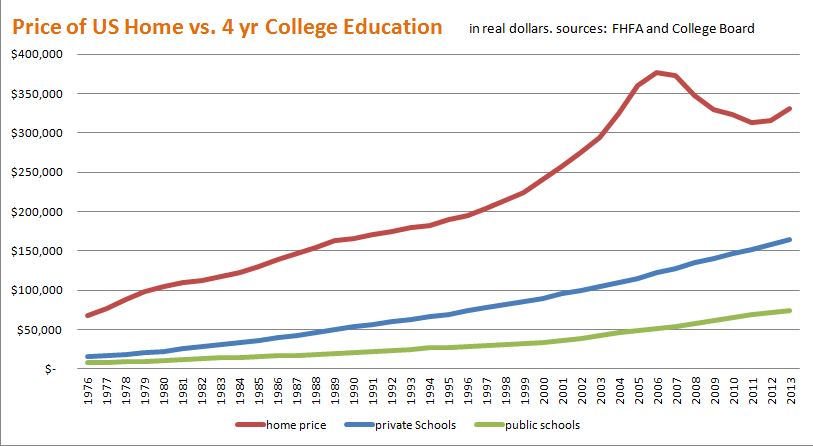
    Let’s examine two sets of numbers if for nothing else, for being probably the largest and most important and the largest single investment in our life. With an eye to college education expenditure, over a period of 4 years how does it fare against what we perceive as the most important single investment   our home.

    In the past 40 years, the average cost for a four-year college education (tuition, room and board) in the U.S. has gone from about $2,400 to nearly $30,000 per year today. Adjusted for inflation the price went up from $12,700 to $30,000. When compared to housing, the average home price 40 years ago was about $35,000 and today $331,000. Adjusted for inflation home pricing went up from $172,000 40 years ago to $331,000.

    HomeAndCollegePriceCharts

    The percentage of students carrying debt has shot up from less than half to nearly 70 percent. The avg. price tag of private colleges with room and board is $40,130, up 60% in the past ten years from $25,060. The ratio of Pell Grant to the cost of college education did not change much in the past 10 years and it stands on 14% in private schools and 31% of the cost of public schools.

    Pell Grants Chart

  • Wireless Price War

    Wireless Price War

    [rev_slider wireless_providers]

    Recent data on wireless price suggests an average monthly bill of $61.15 up from $55.80 in the first quarter of 2010. Does this indicate a price war between cellular service providers? This would hardly be the case. But why do consumers think that a price war is underway?

    Lets examine the options:

    Sprint’s “Framily” plans, a group of at least seven people will get unlimited talk, text and 1 GB of data for $25 per month per line. Family members can each pay $20 per month per line to buy unlimited data and new phone every year. To get this seemingly attractive price, seven or more people have to join the group. For individual account, the cost could be as high as $75 per month and as low as $55 per month per line for unlimited talk, text and 1 GB of data.

  • About

    [vc_row][vc_column][vc_column_text css_animation=”left-to-right”]From the moment we make our first purchase at young age, price becomes part of our daily routine. As young adults perhaps we cared less about the price of our little indulgences, but as we grow, so does our calculated awareness of the price of everything around us.

    PriceWize’s mission is to explore the Real Price of Everything, not in the economic sense which is only useful to a handful, but in the review and analysis of current prices of everyday goods and services with the goal of empowering consumers world wide

    We cover a wide range of stuff that we pay for throughout our time on this earth. Things we purchase, lease, rent, trade, acquire and consume; some more regularly, like food and clothing and entertainment and others once or twice in our lifetime. How much do we pay? is all relative to where we live, how old we are, when and where we buy, how badly we need it and how badly the other wants to sell. The are so many variables influencing the price of things, many out of our control, and some within… knowledge is the only force that can drive these variables to the sphere of control, thus allowing us realize the true value of our work.

    Nowadays people know the price of everything and the value of nothing…

    Oscar Wilde

    [/vc_column_text][/vc_column][/vc_row][vc_row][vc_column width=”1/1″][vc_message color=”alert-info” style=”square”]Help us empower our communities! Become a commentator, contributor or send us alerts.[/vc_message][/vc_column][/vc_row]